Get Social With Us
[vc_separator type='transparent' color='' thickness='' up='10' down='10'] [social_icons type="normal_social" icon_pack="font_elegant" fa_icon="fa-adn" fe_icon="social_facebook_circle" size="large" link="https://www.facebook.com/" target="_blank" icon_color="#ffffff"][social_icons type="normal_social" icon_pack="font_elegant" fa_icon="fa-adn" fe_icon="social_twitter_circle" size="large" link="https://twitter.com/" target="_blank" icon_color="#ffffff"][social_icons type="normal_social" icon_pack="font_elegant" fa_icon="fa-adn" fe_icon="social_linkedin_circle" size="large" link="https://www.linkedin.com/" target="_blank" icon_color="#ffffff"][social_icons type="normal_social" icon_pack="font_elegant" fa_icon="fa-adn" fe_icon="social_instagram_circle" size="large" link="http://instagram.com/" target="_blank" icon_color="#ffffff"]

Why THIS Winter is the Best Time to Buy an Investment Rental Property

As February rolls on and spring approaches, many investors assume the best deals are still ahead.  But the truth is ~ WINTER IS THE SMARTEST TIME to buy an investment rental property!

As I Tell My Clients, Buying in the Winter Means:

  1. Less Competition = Better Deals. 
    Winter sees fewer buyers in the market. Less competition means better negotiating power. Sellers listing in winter are often motivated, whether due to job relocations, financial needs, or simply wanting to close before spring. This is your chance to secure properties at better prices!

  2. Motivated Sellers & Faster Closings. 
    Winter sellers are often more eager to sell, which benefits YOU as an investor. And fewer buyers (see Reason #1), means you can negotiate better prices, seller concessions, or even repairs. Plus, with fewer transactions happening, mortgage lenders and title companies process paperwork faster, leading to quicker closings.

  3. Stronger Inspections = Smarter Investments.
    Winter Buying lets you see how a property holds up in tough conditions. You can check heating efficiency, look for drafts, and assess how the roof and insulation handle snow and rain. These insights help you plan improvements before peak rental season.

  4. Get Ahead of the Rental Season.
    Buying in the winter gives you time to make updates and have the property ready for peak spring and summer rentals, when demand is highest.

  5. Slower Housing Market  – THIS Winter is a Rare Opportunity! 
    With higher interest rates, the real estate market has slowed. Sellers are more flexible, and prices are negotiable. But once interest rates drop, demand will skyrocket, and prices will rise.

The best investors take action BEFORE the crowd. Will you?

📩 Let’s talk!

➡️ Schedule a call today, and let’s find the right rental property for you before the market heats up. 🔥🏡

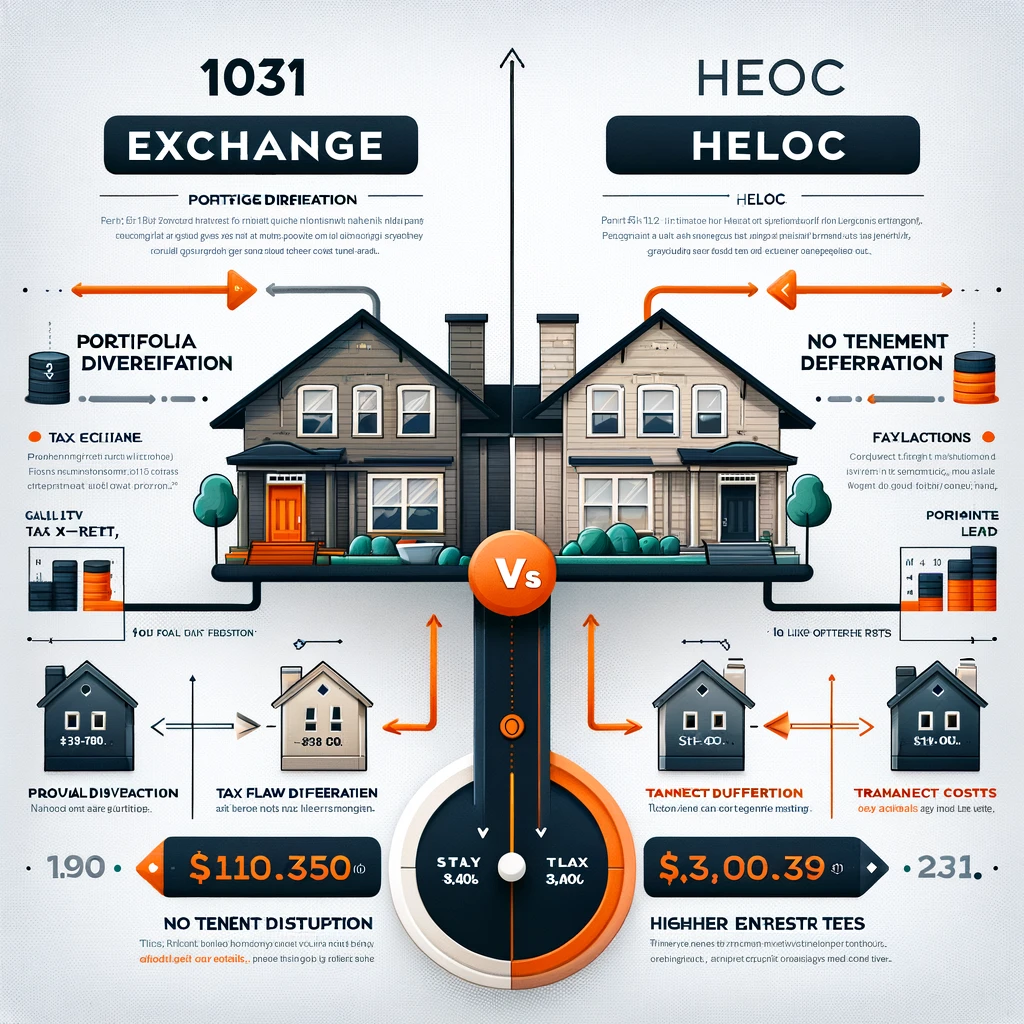
Leveraging Equity in Your Investment Property: 1031 Exchange vs. HELOC

As a real estate investor, one of your greatest assets is the equity built into your properties. Tapping into this equity can be a powerful strategy for growing your portfolio or maximizing returns. But what’s the best way to do it? Today, we’ll explore two primary methods: leveraging a 1031 Exchange or using a Home Equity Line of Credit (HELOC). Each has its own advantages, disadvantages, and financial implications. Let’s dive into the details so you can make the best decision for your investment strategy.


Option 1: Selling via a 1031 Exchange

A 1031 Exchange allows you to defer capital gains taxes by reinvesting the proceeds from selling a property into one or more “like-kind” properties. For an investor with significant equity, this can be a game-changer.

How It Works

  • Sell your current property.
  • Use the proceeds to purchase two (or more) new investment properties of equal or greater value.

Advantages

  1. Portfolio Diversification: By acquiring multiple properties, you spread your risk and expand your income streams.
  2. Tax Deferral: The 1031 Exchange helps you defer capital gains taxes, preserving more of your capital for reinvestment.
  3. Increased Equity Utilization: Your equity now works across multiple properties instead of being tied up in one.

Disadvantages

  1. Transaction Costs: Selling involves agent fees, closing costs, and other transaction expenses.
  2. Preparation Hassles: You may need to renovate or refresh the property to attract buyers, which adds to your costs and time investment.
  3. Tenant Disruption: Tenants may need to vacate, interrupting rental income and creating potential legal or logistical challenges.
  4. Timing Constraints: The IRS imposes strict timelines on identifying and closing on replacement properties, adding pressure to the process.


Option 2: Using a HELOC to Fund a Down Payment

A Home Equity Line of Credit (HELOC) lets you borrow against the equity in your property. This line of credit can be used to fund the down payment for a new investment property without selling your existing asset.

How It Works

  • Take out a HELOC based on the equity in your current property.
  • Use the borrowed funds as a down payment on another investment property.

Advantages

  1. Less Disruption: There’s no need to sell your property, relocate tenants, or pause rental income.
  2. Immediate Access: HELOC funds are accessible quickly and can be used regardless of the property’s current occupancy.
  3. Flexibility: HELOCs are revolving lines of credit, meaning you can borrow, repay, and borrow again as needed.
  4. Lower Interest Costs: HELOCs typically use simple interest, which can save money compared to the compounding interest of traditional loans.

Disadvantages

  1. Higher Interest Rates: HELOCs often come with variable rates, which can increase over time.
  2. Cash Flow Impact: Monthly payments on the HELOC may reduce your overall cash flow, although typically less than the costs associated with selling a property.


Comparing the Two Options

Aspect 1031 Exchange HELOC
Tax Benefits Defers capital gains taxes None
Cost High transaction and preparation costs Lower upfront costs
Impact on Cash Flow Minimal, as new properties generate income Some impact due to HELOC payments
Operational Disruption Requires tenant relocation and property prep No disruption; property remains operational
Flexibility Limited to reinvestment timelines Highly flexible and reusable line of credit


Key Takeaways for Investors

Both options allow you to unlock the equity in your investment property, but the best choice depends on your goals and circumstances.

  • If your priority is expanding your portfolio and diversifying risk, a 1031 Exchange might be the way to go. Just be prepared for the costs and operational disruptions.
  • If you prefer speed, flexibility, and minimal disruption, a HELOC offers a convenient alternative with potentially lower costs over time.


Final Thoughts

Understanding the financial impact of these options is crucial. While a 1031 Exchange might help you scale your portfolio, a HELOC could provide a more cost-effective and streamlined way to grow your investments.

As always, it’s important to model your specific financial situation to make an informed decision. By comparing cash flow, total costs, and long-term returns, you can confidently choose the strategy that aligns with your investment goals.

Are you ready to explore these strategies further? Let’s run the numbers and find the best path forward for your portfolio.


Pro Tip

Consult with a tax professional and financial advisor before making significant investment decisions. They can provide personalized guidance tailored to your specific financial landscape.

Disclaimer: This analysis is for informational purposes only and should not be considered financial advice. Always conduct thorough due diligence and consult with qualified financial professionals.

Mortgage Programs: How Investors Use Them Wisely

[vc_row row_type=”row” type=”full_width” text_align=”left” video=”” css_animation=””][vc_column][vc_column_text]I recently had a conversation with a potential new investor and he asked me “With rates being where they’re at, do you think it’s a good idea to wait to start investing?”

My response was something along the lines of…

While you’re waiting for rates to “maybe” go down sometime in the future, you are “for sure” losing out on the appreciation your property would have made during that time.  Appreciation is where you are going to be making the bulk of your wealth and I think it’s foolish to forego that gain in order to wait out interest rates.  You can always refinance down the line if/when rates do go down, but you can’t ever go back and pay less for your house.

[/vc_column_text][vc_empty_space][/vc_column][/vc_row][vc_row row_type=”row” type=”full_width” text_align=”left” video=”” css_animation=””][vc_column][vc_single_image image=”306214″ img_size=”full” alignment=”center” style=”vc_box_shadow” qode_css_animation=””][vc_empty_space][/vc_column][/vc_row][vc_row row_type=”row” type=”full_width” text_align=”left” video=”” css_animation=””][vc_column][vc_column_text]In times like these, I also urge investors to take advantage of different loan programs that are offering lower rates.  Adjustable Rate Mortgages (ARM) can be beneficial to a buyer who is maybe planning to refinance or sell in the next 5, 7, 10 or 15 years.  These loans typically offer lower interest rates but still a fixed period at the beginning of the loan term (some up to 15-years fixed period!).  The payments are still amortized over 30-years and act like a traditional 30-year mortgage during that fixed period.

We always urge investors to think about the long-term gains and stay in the real estate market for the maximum amount of wealth building opportunity.  That does not mean that you must buy and keep the same real estate properties if there are more beneficial opportunities out there.  The average investment property is held for approximately 5-years.  Why would you invest the extra money in a higher rate to secure a fixed period you will not be using?


Image by Freepik[/vc_column_text][vc_empty_space][/vc_column][/vc_row][vc_row row_type=”row” type=”full_width” text_align=”left” video=”” css_animation=””][vc_column][vc_separator type=”normal” color=”#81d742″][/vc_column][/vc_row]

Tap into your Rental House Equity!

That rental property you bought with us over 6.5 years ago may buy you additional rentals!
 
Have you checked your rental house’s value recently?
 
My guess is it went up significantly since you purchased it!
 
When was the last time you calculated how much you have gained from value increase + mortgage principal reduction + cash flow (- additional expenses)?
 
The main challenge we are seeing with properties that were purchased some 7+ years ago is that the rent did not keep up with the value increase.
 
Meaning – it is possible the value has increased 30% or even 50% since you purchased it (in some cases even doubled) but the rent only went up 10-20%, maybe a bit more.
 
The big question is how do you tap into that equity? or should you tap into your equity?  
 
Here’s the challenge – if you refinance and pull cash out, you may reduce the cash flow and hurt the property’s stability. Or it is possible you will only be able to pull out a small amount of cash which won’t be enough to buy another property.  
 
So what are your options? 
 
Option I – do nothing and keep enjoying the cash flow.
 
Option II – refinance and don’t take cash out or take very little making sure you keep a minimal required cash flow – MRC.
At a minimum, I suggest taking advantage of the current super-low mortgage rates and better your cash flow by getting a new mortgage with a lower rate – in case you have not done so already.
 
Option III – sell or better yet 1031 exchange and utilize your gained equity to buy TWO or more properties instead of the one you currently own. 
In short, 1031 exchange is a legal tax defer (not tax elimination) mechanism that allows you to defer tax to a future time. 1031 exchange is a bit more complex. You should consult with the right professional about it.
 
Here are a few challenges we think you should be aware of and we can help you with:
  • Refinance duration – these days it takes approx. 40-50 days to complete a refinance – lenders are swamped.
  • Selling while occupied – if you want to sell and your house is tenant-occupied that may be difficult. If you call us, we may be able to assist in such a situation.
  • Buying these days – inventory levels in most US metros are low and demand for housing is high. This works in your favor if you are selling but will make it harder if you are buying, especially if you are doing a 1031 exchange. In case you are doing a 1031 exchange, we may be able to assist you better in meeting your 1031 exchange requirements. If you call us, we may be able to assist in such a situation.
 
Confused? Not sure what to do? Call me and let’s explore your options.

Not Boring vs. Boring Investment

Here’s how a NOT boring investment looks like:

In 1952 built house, 850 square feet, two bedrooms one bathroom, for $60,000, in not so good school district, with tenants who pretty much live paycheck to paycheck.

This type of an investment will most likely generate more vacancies, more evictions, and more repairs.

On paper this one probably looks amazing but in reality it typically does not.

Every house has repairs, but then older houses when a repair comes up, it’s usually means a bigger expense because you have to update things up to code and we dealing with older plumbing, older electrical wires, and older mechanical.

Here’s how a BORING investment looks like:

A 1980 or after built, three to four bedrooms, two to three bathrooms, maybe a den or an office, 1,150 square feet or more, two-car garage, in a nice community, in a good school district, with tenants that have good jobs for about $150,000.

Such a property will typically generate less “noise”, will most likely hold tenants for a longer period of time, and with minimal hiccups. It will be attractive to other tenants when the house is vacant, be attractive to sellers when you decide to sell the house, and when things break it will most likely generate smaller repair bills.

Many investors are attracted to the cheaper property which is actually the NOT boring one. They find it more exciting to have such a property but in reality it turns out to be the a bigger hassle and more headache then they wanted to get into in the first place.

Ways to Overcome Buying Challenges in Today’s Marketplace

[vc_row row_type=”row” type=”full_width” text_align=”left” video=”” css_animation=””][vc_column][vc_column_text]I want to take a minute or two to talk about the challenges many of our investors are facing these days – high competition and low inventory.

[spacer height=”20px”]   

[spacer height=”20px”]

In most of the markets where Simply Do It is active, buying is very difficult. We are seeing multiple offers on every good house coming from buyers in the marketplace.


Inventory level in most areas is relatively low, which makes it even more difficult to buy.


The reality is not very good for us investor buyers nowadays.


So what can you do?


These options may not be relevant for all investors. But for some, they may will be.


  1. If there’s a way for you to make a cash offer, you should consider it. It will give you an advantage. You should not give up on financing. It only means you need to incorporate financing in a second step. This option is known as delayed financing. If you decide to do it, make sure you work with your lender on the execution.


  1. Try targeting houses that need more work. Historically, we mainly purchased houses that need approximately $5,000 or less in what we call “make-ready.” In some of the markets we are in, such as Dallas, Nashville, and Tampa; we have the local infrastructure that can handle bigger make-ready jobs than $5000.


Do understand, we are not referring to a full renovation work. But actually, we are referring to houses that need updating such as a new roof, new flooring, new paint job, and maybe a few other touch up items that may require $10,000 to $20,000.


Typically, such an improvement will result in a house that has a higher value and will get a higher rent once work is completed.


We know that not every investor is comfortable with doing this or has the liquidity to complete such a mini-project. But if you are one of those who do have that ability and comfort zone, you should definitely consider doing that.


  1. If you are able to combine number one and number two – even better.


  1. Consider relaxing your investment parameters. For example in some of the markets such as Dallas, we have found that houses priced at $220,000 to $270,000 will still generate the cashflow we are looking for – maybe even a bit higher than the houses that cost below $200,000.


Another option is maybe buying a bit older homes then you would consider at the moment or houses that are in less of a perfect school district.


  1. It is possible we are seeing one silver-lining and that’s the increase of the interest rate. You may be thinking that the interest rate going up is actually bad for you, but I beg to differ. We are already seeing reports that there are less applications for mortgages. This means maybe more and more buyers are moving to the sidelines. And if there are less buyers in the marketplace, we may see a shift for a seller’s market to a buyer’s market.


  1. Do not get discouraged. It is a tougher market to purchase. But, we are still seeing many of our investors succeeding in buying additional properties.


  1. Lastly, we are working on an additional strategy to help you get an advantage in the current Marketplace.


You should not get intimidated by the higher interest for the following reasons:

  1. Even at around 5% rate for investors, you are still looking at a relatively lower rate.
  2. It is very likely that you will refinance your current mortgage to a lower rate in the coming years. How soon will that happen – we don’t know. But, you should not assume you are locking yourself into the current rate for the next 30 Years.
  3. In order to mitigate the higher rates, you can consider putting 25% down or even 30% down. Putting a larger down would benefit you by both: having a better rate and slightly better cash flow.


We hope this information helps you rethink or re-calibrate your next purchase.


If you are still confused or not sure what to do, we suggest you let us know so we can set up a time to further discuss your specific challenges.


As always, I wish you success with your investment and thank you for letting us be a part of that Journey.[/vc_column_text][/vc_column][/vc_row]

7 Characteristics of a Profitable Rental Property

Regardless of whether you’re a seasoned investor or a novice who is just starting your real estate investment journey, when it comes to rental property investments, the long-term goal is to select properties that will continue to hold occupancy and maintain a steady source of income.  Your success or failure in investing depends on your ability to select profitable “cash-flow” properties.  Although this might appear to be a daunting task, there are key features or characteristic that you’ll always find in a profitable rental investment.

Here are the top seven characteristics to look for in any potential rental investment property:

  1. Neighborhood:  The neighborhood you select will be the determining factor on the type of tenants your rental property will attract.  Select a neighborhood that has consistent housing prices and few empty or unsold houses, is serviced by good schools, is not dependent on a university or other seasonal tourists support, and is not next to multi-unit housing.  A neighborhood that fits within these parameters is more likely to attract reliable tenants and support a rental house that wishes to be filled more often than it is vacant.
  2. Property Taxes:  The goal is to make money on your investment, so you want to be aware of the property taxes for any perspective property.  Selecting a home that will eat more than 50 percent of your income via property taxes isn’t a wise long-term investment.
  3. Commutability:  Believe it or not, the commutability of a home is one of the top deciding factors for anyone looking to rent.  If the potential property is too far from their job, perspective tenants won’t even consider looking at your property, no matter how much potential it has.  Do your research to find out what major employers are already in the area or might be coming to the area in the near future.  Big employers require a large pool of employees — which means more perspective tenants for your property.
  4. Local Amenities:  Let’s face it, no one wants to live any place where it will take them 20 minutes to drive to the nearest grocery store or restaurant.  Drive the area and see for yourself what amenities it offers — how many grocery stores or restaurants are close by; are there near by parks or community pools; are there local events or farmers markets; and are there other venues, such as theatres, malls or gyms near by.  Amenities mean convenience and that equates to a more attractive rental opportunity for perspective tenants.
  5. Future Development Plans:  The local municipal planning department will have details on any new developments that are slated for the area.  Getting into a great neighborhood with tons of future growth plans is definitely a key for a successful long-term rental investment property.
  6. Listings and Vacancy Activity: Too many listings or rental vacancies in one area could be a sign of a neighborhood that has “gone bad” or one that is no longer desirable.  It would be hard for your rental property to compete in an area that is already saturated by listings —- especially if those listings have been sitting for a lengthy period of time.  Also, high rental vacancy rates could potentially require you to drop your rent in order to complete, which will impact your return on your investment and income.
  7. Curb Appeal:  When it comes to real estate, looks matter!  When choosing your rental investment, select a home that has curb appeal…one that when a potential tenant drives up to it, it immediately gives them a sense that this is a warm and inviting house.  You’ll want a house with landscaping you can maintain, an updated exterior and one with a modern/maintained fence.  If potential tenants pull up to a property with a delapitated fence, loose siding and a yard full of weeds, the odds of them stopping and coming inside to take a look will decrease exponentially.

Once you understand the characteristics of a profitable rental investment, you’ll find it will become second nature to choose the best fits for your portfolio when evaluating properties.

Looking to further expand your investment portfolio or take your first steps on your real estate investment journey?  Then contact the Simply Do It team and let us assist you in finding the best properties for your portfolio and guide you towards long-term success.

Flip or Rental: What’s Your Best Real Estate Investment Option

Flip or Rental: What’s Your Best Real Estate Investment Option

The Simply Do It real estate investment network offers two types of real estate investment opportunities: flipping or renting.  Both options undergo a stringent due diligence process before being presented to our investors, so you can be sure that they are going to be worthwhile; but as a new investor, how do you know which option is better for you?

Before you can answer that question, you must first determine your investment goals.

  1. Are you looking for a long-term investment or a short-term investment?
  2. How much do you have to invest?
  3. Do you have a target amount you are wanting to obtain for a specific purchase or are you simply wanting grow your financial security?

Once you’ve established the answers to these questions, you will be able to sit down with our investor team and create a custom strategy that will assist you in achieving your financial goals.

Flipping vs. Renting

Now that you’ve established what your investment goals are, it’s time to take a closer look at the available options and decide what will work best in helping you achieve your end goals.

Flips

The first option is to invest in flipping properties; the best option for someone with short-term goals. The draw to flipping is that it will typically produce a quicker return on your investment, as most flips last between 5-6 months.

While there is a certain draw to receiving a quicker return, you do run the potential risk of things going wrong during the flip, such as the house not selling quickly and it sits on the market for additional months.

While the unknown risks might sound scary initially, the Simply Do It local teams are used to dealing with them and have the expert experience and knowledge to quickly mitigate them should they arise.

Rentals

The second option is ideal for anyone seeking a longer-term investment opportunity.  Rental investments will not produce the quick windfalls of their flipping counterparts; however, they can create a passive income from your overall portfolio of properties.

While there are still risks associated with investing in rentals, you’ll find that the Simply Do It team has the knowledge and experience to pick the smartest rental investment properties.  They will also work with you, teaching the skills needed to manage your properties for the long haul.

Rentals AND Flips

The third and final option is to create a real estate portfolio that includes both flips and rentals.  This strategy will provide you with quick returns while also setting you up for a longer-term, continual source of income.

Regardless of the path you choose, the Simply Do It investment team will work with you to help you establish what is best for your investment goals and will be there with you every step of the way to guide you through the entire process.

Ready to start down the path of real estate investment?  Then contact the Simply Do It team and take the first step towards your investing future.

Investor’s Step 1 – One on One Strategy Session (Free)

It’s Action Taking Time!

We invite you to have a one-on-one conversation with Simply Do It‘s CEO Mr. Dani Beit-Or (read about Dani).

We are certain you have many questions and concerns about investing and want to accomplish your goals.

This 30 minute session will help you move forward with residential real estate investing, particularly in owning your own residential rental or following through on flipping residential properties.

During the meeting, we should be able to accomplish the following:

  • Discuss your goals
  • Create an action-items list
  • Define prerequisites for getting started – are you ready?
  • Identifying and finding ways to overcome obstacles
  • Put together ideas and thoughts into actions

You can learn more about Simply Do It‘s Guided Investing and how it can benefit you.

Meetings are typically by phone, Skype or in-person (Irvine CA).

Cost: FREE! ($375 value)

To Register (complete the Intake Form): SimplyDoIt.net/intake

After you complete the meeting Intake form, we will get back to you to schedule a time based on availability.

It’s time for you to take charge of your investments.