Get Social With Us
[vc_separator type='transparent' color='' thickness='' up='10' down='10'] [social_icons type="normal_social" icon_pack="font_elegant" fa_icon="fa-adn" fe_icon="social_facebook_circle" size="large" link="https://www.facebook.com/" target="_blank" icon_color="#ffffff"][social_icons type="normal_social" icon_pack="font_elegant" fa_icon="fa-adn" fe_icon="social_twitter_circle" size="large" link="https://twitter.com/" target="_blank" icon_color="#ffffff"][social_icons type="normal_social" icon_pack="font_elegant" fa_icon="fa-adn" fe_icon="social_linkedin_circle" size="large" link="https://www.linkedin.com/" target="_blank" icon_color="#ffffff"][social_icons type="normal_social" icon_pack="font_elegant" fa_icon="fa-adn" fe_icon="social_instagram_circle" size="large" link="http://instagram.com/" target="_blank" icon_color="#ffffff"]

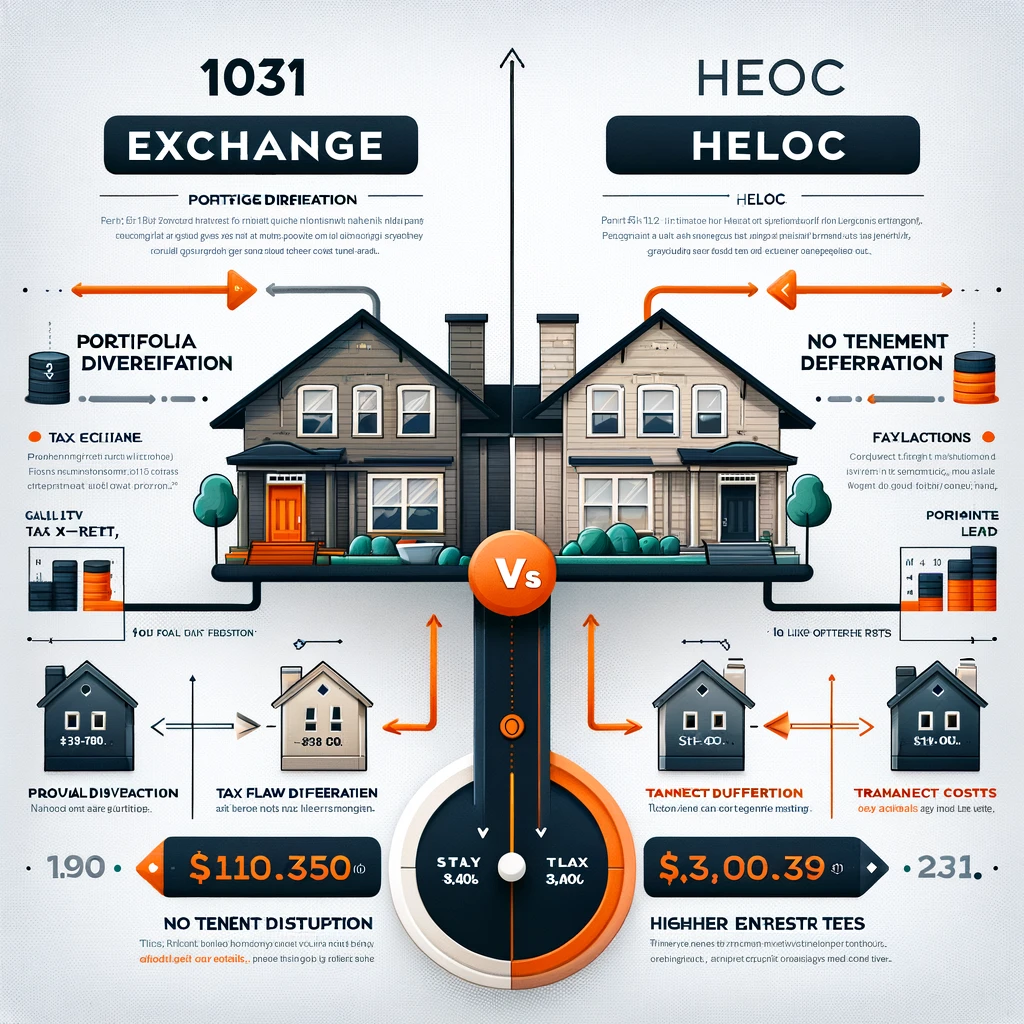
Leveraging Equity in Your Investment Property: 1031 Exchange vs. HELOC

As a real estate investor, one of your greatest assets is the equity built into your properties. Tapping into this equity can be a powerful strategy for growing your portfolio or maximizing returns. But what’s the best way to do it? Today, we’ll explore two primary methods: leveraging a 1031 Exchange or using a Home Equity Line of Credit (HELOC). Each has its own advantages, disadvantages, and financial implications. Let’s dive into the details so you can make the best decision for your investment strategy.


Option 1: Selling via a 1031 Exchange

A 1031 Exchange allows you to defer capital gains taxes by reinvesting the proceeds from selling a property into one or more “like-kind” properties. For an investor with significant equity, this can be a game-changer.

How It Works

  • Sell your current property.
  • Use the proceeds to purchase two (or more) new investment properties of equal or greater value.

Advantages

  1. Portfolio Diversification: By acquiring multiple properties, you spread your risk and expand your income streams.
  2. Tax Deferral: The 1031 Exchange helps you defer capital gains taxes, preserving more of your capital for reinvestment.
  3. Increased Equity Utilization: Your equity now works across multiple properties instead of being tied up in one.

Disadvantages

  1. Transaction Costs: Selling involves agent fees, closing costs, and other transaction expenses.
  2. Preparation Hassles: You may need to renovate or refresh the property to attract buyers, which adds to your costs and time investment.
  3. Tenant Disruption: Tenants may need to vacate, interrupting rental income and creating potential legal or logistical challenges.
  4. Timing Constraints: The IRS imposes strict timelines on identifying and closing on replacement properties, adding pressure to the process.


Option 2: Using a HELOC to Fund a Down Payment

A Home Equity Line of Credit (HELOC) lets you borrow against the equity in your property. This line of credit can be used to fund the down payment for a new investment property without selling your existing asset.

How It Works

  • Take out a HELOC based on the equity in your current property.
  • Use the borrowed funds as a down payment on another investment property.

Advantages

  1. Less Disruption: There’s no need to sell your property, relocate tenants, or pause rental income.
  2. Immediate Access: HELOC funds are accessible quickly and can be used regardless of the property’s current occupancy.
  3. Flexibility: HELOCs are revolving lines of credit, meaning you can borrow, repay, and borrow again as needed.
  4. Lower Interest Costs: HELOCs typically use simple interest, which can save money compared to the compounding interest of traditional loans.

Disadvantages

  1. Higher Interest Rates: HELOCs often come with variable rates, which can increase over time.
  2. Cash Flow Impact: Monthly payments on the HELOC may reduce your overall cash flow, although typically less than the costs associated with selling a property.


Comparing the Two Options

Aspect 1031 Exchange HELOC
Tax Benefits Defers capital gains taxes None
Cost High transaction and preparation costs Lower upfront costs
Impact on Cash Flow Minimal, as new properties generate income Some impact due to HELOC payments
Operational Disruption Requires tenant relocation and property prep No disruption; property remains operational
Flexibility Limited to reinvestment timelines Highly flexible and reusable line of credit


Key Takeaways for Investors

Both options allow you to unlock the equity in your investment property, but the best choice depends on your goals and circumstances.

  • If your priority is expanding your portfolio and diversifying risk, a 1031 Exchange might be the way to go. Just be prepared for the costs and operational disruptions.
  • If you prefer speed, flexibility, and minimal disruption, a HELOC offers a convenient alternative with potentially lower costs over time.


Final Thoughts

Understanding the financial impact of these options is crucial. While a 1031 Exchange might help you scale your portfolio, a HELOC could provide a more cost-effective and streamlined way to grow your investments.

As always, it’s important to model your specific financial situation to make an informed decision. By comparing cash flow, total costs, and long-term returns, you can confidently choose the strategy that aligns with your investment goals.

Are you ready to explore these strategies further? Let’s run the numbers and find the best path forward for your portfolio.


Pro Tip

Consult with a tax professional and financial advisor before making significant investment decisions. They can provide personalized guidance tailored to your specific financial landscape.

Disclaimer: This analysis is for informational purposes only and should not be considered financial advice. Always conduct thorough due diligence and consult with qualified financial professionals.

Self Dictating Your Mortgage Points

For investors, understanding the concept of points in mortgages can be tricky. It’s often challenging to decide whether it’s worth buying points or not.

But what if I told you there’s a third option, one that many mortgage lenders may not prefer?

Let’s begin with some basics, but if you’re already familiar with what points are, feel free to skip ahead to . . . An Alternative Approach: Holding the Money Separately.


Determining whether to pay points or manage your mortgage points yourself boils down to how long you plan to keep your mortgage. In simpler terms, it’s about when you expect to pay it off or refinance, and your prediction of how interest rates will behave in the future—whether they’ll rise, fall, or stay the same over the next few months or years.


Understanding Mortgage Points

Mortgage points are upfront fees that you can pay to your mortgage lender in exchange for a lower interest rate on your loan. Essentially, you’re buying down the interest rate. Here’s how it works:

  1. Cost of Points: Each point you buy costs 1 percent (1 pt – 1%) of your mortgage amount. For instance, if you have a $300,000 mortgage, one point would set you back $3,000.
  1. Interest Rate Reduction: By purchasing points, you can reduce your loan’s interest rate. This means a lower monthly payment over the life of your mortgage.
  1. Prepaid Interest: Think of mortgage points as a form of prepaid interest. You pay upfront to enjoy long-term savings.


Why Consider Mortgage Points?

Now, let’s explore why using the concept of mortgage points can be a smart move:

  1. Immediate Savings: Paying points upfront allows you to immediately lower your interest rate. If you plan to hold your mortgage for a while, this can translate into significant savings over the years.
  1. Breakeven Point: Before buying points, calculate the breakeven point. This is the point at which the interest savings from the lower rate offset the upfront cost of the points. If you’ll recoup the cost within a reasonable timeframe, it’s a good deal.
  1. Example with a $100,000 Mortgage:
    • Suppose you have a $100,000 mortgage.
    • You decide to buy one point (1% of $100,000), which costs $1,000.
    • This lowers your interest rate by 0.25%.
    • Over the loan term, this reduction could save you hundreds or even thousands of dollars.
    • If you plan to keep the mortgage long enough to recoup the $1,000, it’s a wise choice.


An Alternative Approach: Holding the Money Separately

Now, let’s discuss an alternative strategy. Instead of paying points directly to the lender, consider this:

  1. Hang on to the point money: instead of paying it at closing to the mortgage co. keep it, put it in one of your accounts, mentally allocate or notate it as the points for address 123 Main St. so you know the money is set aside for this purpose. 
  1. Apply Against Mortgage Payment: When your mortgage payment is due, use those funds from to make an extra payment. Essentially, you’re paying the points yourself.


Why Is This a Better Decision?

  • Flexibility: By holding the money separately, you retain flexibility.
  • Interest Savings: You still benefit from the interest savings without committing the money permanently to points.
  • No Upfront Cost: Unlike paying points directly, there’s no immediate upfront cost. You decide when to apply the funds.
  • In case you refinance the mortgage before the breakeven point – you just saved yourself money.


Example:

Purchase price $300,000

1 2
Downpayment % 30% 30%
Downpayment $ 90,000 90,000
Loan Amount 210,000 210,000
Int. rate 7.50% 7.00%
Length (yrs) 30 30
Points % 0.00% 1.00%
Points $ 0 2,100
Cost per month (over 30 yrs) $0.00 $5.83
Monthly payment (PMT) $1,397 $1,468
———————-
In this example:
  • The 1 pt is equal to saving of $71 per month
  • The breakeven point is ~30 months or ~2.5 years

———————-

Setting aside 1 pt / $2100, and paying every month $71 towards your mortgage payments is similar to paying the point upfront, BUT YOU HANG on to it, here are the saving you will have:
———————-
Months Until Refi  $ Spent Your Saving
12 $855 $1,245
18 $1,282 $818
24 $1,709 $391
30 $2,136 -$36
36 $2,564 -$464

———————-

Based on this example if you refi your mortgage after 12 months you have just saved $1,245, but if you refi after 36 months – you have “lost” $464


Short Sale – Short Explantion

First, instead of explaining let’s use an example.

Let’s say a buyer purchase a house 2 years ago for $200,000 and put $20,000 downpayment and took a mortgage of $170,000.

Now let’s assume there was shit in the market and the value of the property today, 3 years after he purchased it, is $160,000.

Further, let’s assume the buyer cannot make his monthly mortgage payments.

Situation: $160,000 house with a mortgage of $170,000 and a borrower who cannot make the payments.

A Short Sale is an option for an owner to sell his house for LESS THAN WHAT’S OWED – in this case for $160,000.

In order for a Short Sale to go through the lender needs to approve the selling price since the lender is going to take a loss.

In other terms, the house is being sold at short to what owed.


Second, now that we understand what is a Short Sale let’s understand the complexity.

Note: keep in mind the mechanics can be different between one lender to another.

Typically, the owner/borrower need to

  1. List the property for sale at market value, ie for under owed amount.
  2. When there is an offer (#1) submit the offer to the lender to approve a Short Sale.
  3. Wait 3/6/9 months until lender response/dis/approves the offer price (or not).
  4. Put the house bank on the market, since offer #1 is probably gone by now.
  5. Wait for offer #2 – typically the 2nd approval process with the lender is quicker

How to Buy a Short Sale

  1. Ask the seller where in the approval process is the house?
  2. Submit an offer which includes:
    1.  Zero or very small earnest money amount until lender’s approval is received.
    2. Only hold an inspection AFTER the lender’s approval is received.
    3. Terminate the contract at any point of time before lender’s approval.

FAQ

Q: Is there any reason to a buyer to be concerned about buying a short sale?
A: No. The Short Sale is on the seller/owner side and doesn’t “transfer” to you the buyer.

Q: Is a house sold as a Short Sale indicates on a problematic house?
A: Not necessarily. Every house needs to be inspected and evaluated regardless if is a Short Sale or not. Short Sale typically indicates the situation of the owner.

Note

Please do not see this explanation as a full explanation or suggestion about the Short Sale process.


2018 US Migration Patterns by North American Van Lines

According to the latest information published by the U.S. Census Bureau the percentage of people that move every year equates to 14% of the population (or roughly 40 million). People move for a variety of reasons: housing, jobs, family, etc.  Being aware of cross country moving migration patterns can provide you a better idea on the behavior of Americans. The following historical U.S. migration study will provide you the states with the largest influx of moves and the states that have the most outbound moves. 

Read more

North American Migration Map – An infochart by the team at North American Van Lines

How To Beat The Competition

When homes sell in minutes and offers accept way over list price, how do you stand a chance?

In recent months, I have seen a significant increase in our investors’ frustration level.

To quote one of our investors:
“There’s a limit on how responsive you can be. Today the agent published 4 new houses. I replied in less than one hour but all got sold in 15 minutes. How can you beat that? No one checks emails every 5 minutes…”

We are seeing a “storm” of multiple factors: high-demand for good properties by the marketplace, low inventory levels during seller’s market period, and houses that do pass our criteria that still need to cashflow.

So what can you do?

Be a part of our“Frustration Free” SFHs Fund for buying bulks!

  • Access properties that are not offered to the public. Most times, such sellers are not interested in liquidating one property at the time, but to liquidate a package of houses.  
  • Typically, houses purchased in a package are all, or mostly, rented.
  • Pain-free ownership and hassle-free investment portfolio management.
  • Vacancy distribution – never have 100% vacancy at one time.


Direct vs. Indirect Ownership

For years, I personally believed that direct ownership, i.e. you own the property, is the best way to go for a variety of reasons. Main reason being financing.

These days, I admit I have a new take on it. And think indirect ownership is another good option for investors. You invest in a fund that is professionally managed. The fund holds a large number of rentals and obtains financing.

This doesn’t mean indirect is better than direct or vice versa. Both options are good and can help you accomplish similar financial goals. And in many ways, one compliments the other.

Indirect opens up possibilities to us that in today’s market direct ownership is limited.

For the past 15 years, I have been guiding and supporting real estate investors. I estimate that during those years I have assisted in the purchase of more than 3500 houses, most purchased as direct ownership.

Throughout all those years, complaints about property managers, vacancy, cost of repairs, and other related ownership issues never stopped. And while always telling our investors to lower expectations from property managers, to see the big picture, and to hang in there – I always felt the need to find a way for us to take this “pain” from our investors. I always wanted to find a way to provide you with less trouble and hassle. Indirect ownership offers that.

Is This Fund For Me?

Do you relate to one or more of the following:

  1. Frustrated from attempting or making offers that do not succeed.
  2. Wish you could buy rented houses vs. vacant ones.
  3. Tired of dealing with ownership “noise” or just wished you could avoid it.
  4. Don’t feel you have the confidence to start or to buy another property, mainly out of state.
  5. Want to avoid the stress of a vacancy of your rental.
  6. Want to outsource the decision making process of selecting a property and outsource the need to deal with the ongoing of ownership.
  7. Already have multiple properties and do not want to add another one directly to your portfolio.


If you answered ‘YES’ to one or more, you’d probably be a good fit for our next Single Family Homes (SFHs) Fund.

You can find more about the next SFHs Fund here: https://reistart.com/s1uxX

Quick summary about the fund

  • Location of houses: North Houston – approx. 30 minutes north of downtown
  • Projected hold period: 10 years
  • Minimum investment amount: $50,000
  • Projected ROI: 15% per year after 10 years – NO GUARANTEES
  • Number of houses: 18
  • Occupancy: rented
  • General house rating: B+
  • Seller reason to sale: reposition portfolio for retirement
  • Cost: $3,000,000*
  • Loan: $2,100,000*
  • Down-payment: $900,000*
  • Other fees and costs: $375,000* (closing costs, make-ready costs, loan cost, required reserve, etc.)
  • Total amount needed: $1,275,000*


* Projected figures.

To participate, you first need to complete the investor suitability questionnairehttps://simplydoit.net/TBcz4

Important to know

  • This type of an investment is not suitable for everyone. We may not be able to accept every interested investor. Our apologies and we hope you understand.  


Contact us with your additional questions.

Good luck with your investing.

All the best,
Dani

Real Estate Trends Bubble by Teo Nicolais

We have found this great simple to under stand piece about real estate trends and bubble and where are we today with respect to the next bubble or bust. 

Read full article on Harvard’s website 

How to Use Real Estate Trends to Predict the Next Housing Bubble

By Teo Nicolais

The next major bust, 18 years after the 1990 downturn, will be around 2008, if there is no major interruption such as a global war.” 
— Fred E. Foldvary (1997)

The destructive wave that swept across the US economy in 2008 seemed to catch the world completely by surprise. The phrase so often used to describe it, a “financial tsunami,” reinforces the popular belief that the disaster arose suddenly.

In reality the build up to the Great Recession could be clearly tracked and its timing predicted with a stunning degree of accuracy long before the phrase “collateralized debt obligation” entered the popular lexicon.

The real cause of the crisis is far older, far more interesting, and far more profitable to understand for those interested in what lies ahead.

As early as 1876, Henry George observed the curious cycle through which real estate markets inexorably move. His findings can be summarized (with the help of Glenn R. Mueller’s refinements) as follows.

A graph from Mueller's book shows the market quadrants

PHASE I: RECOVERY

We know the characteristics of a recession: high unemployment; decreased consumption; and decreased company investment in buildings, factories, and machines. The price of land, essential for economic activity, is at its lowest point in the cycle.

As population increases so does the demand for goods and services. This expansion is typically hastened by government intervention in the form of lowered interest rates (the key ingredient for investment).

With increasing demand and lower investment costs, companies expand their businesses. They hire more people, build new factories, and buy more machines. This expansion adds to the demand for land (buildings) on which the economic activity can take place.

Vacancy across all real estate asset classes (office, retail, residential, etc.) decreases as companies use previously empty buildings and individuals move into previously vacant homes.

PHASE II: EXPANSION

The transition from recovery to expansion occurs when companies and individuals have bought up or rented most of the available buildings. Occupancy begins to exceed the long-term average. As unoccupied buildings become scarce, landowners raise rents.

This graph shows the phases of recovery and expansion

Since most real estate expenses are fixed, increased revenues translate almost dollar-for-dollar into increased profits. Increased profits attract new development of vacant land or redevelopment of existing properties.

Basic economics tells us that new supply will satisfy demand and eliminate the upward pressure on rents and land prices accordingly. But here’s the twist: it takes a long time to add new inventory to the real estate market once it’s needed.

Market studies must be undertaken. Land sales must be negotiated. Zoning and permitting must be obtained. Financing for the project must be found (no easy feat coming out of a recession). Only then does new construction begin. And the construction itself takes a long time (two to five years for the average development).

By the time meaningful amounts of inventory start to come online, the overall economic expansion has been under way—without the benefit of new supply—for five to seven years. During all of that time, occupancy rates and rents have been increasing.

In fact, the cycle reaches a point at which rents are not simply going up—they are going up faster and faster (rent growth is accelerating). Investors build this trend into their forecasts. And we reach that critical point in the real estate cycle where, as William Newman documented as far back as 1935, the price of land begins to reflect not the existing market conditions but rather the anticipated rent growth to come.

Investors, believing the price is justified by the future growth, overpay for the land relative to the current market, and start building for a future market. The boom is officially on.

PHASE III: HYPER SUPPLY

As long as the current occupancy rate exceeds the long-term average, there will be upward pressure on rents. As long as there is upward pressure on rents, new construction is financially feasible. This is the case for both the expansion and hyper-supply phases.

The First Indicator of Trouble

The delineation point between expansion and market hyper supply is marked by the first indicator of trouble in the real estate cycle: an increase in unsold inventory/vacancy.

A line graph showing the characteristics of the expansion to hyper supply phases

This occurs as new completions from the mid-expansion phase begin to quench the market’s thirst for product. With occupancy rates above the long-term average, rents are still rising but the rate at which they are rising now changes: rent growth is no longer accelerating, but rather decelerating.

This is a precarious time in the real estate cycle. And what happens next will determine how severe the upcoming recession will be.

Wise developers, noting the change in direction of rent growth and factoring in the likely consequence of units currently under construction being completed, should choose to stop building. If you find such a developer, please let me know.

PHASE 4: RECESSION

The Second Indicator of Trouble

The transition from hyper supply to recession is marked by the second indicator of trouble in the cycle: occupancy falls below the long-term average.

New construction stops, but projects started in the hyper-supply phase continue to be delivered. The addition of surplus inventory leads to lower occupancy and lower rents, which significantly reduces revenue for landowners.

A line chart that shows the transition from hyper supply to recession

The Third Indicator of Trouble

Finally, investors must watch for the third indicator of trouble: an increase in interest rates.

The increases in prices throughout the broader economy that accompanied the expansion and hyper-supply phase will, sooner or later, force the Federal Reserve to fight inflation by increasing interest rates.

The good news is that this halts any developers still forging ahead in hyper-supply mode because the increase in borrowing costs makes new developments financially unfeasible.

The bad news is that it’s too late for the projects started in the midst of the boom. The music stopped, but there are still people rushing toward the dance floor.

The combination of lower occupancy, lower rent received on those occupied units, and increased interest expenses (a large fixed cost) quickly erodes landowners’ profits.

There are broader issues from the shutdown of the economy’s largest growth engine (new construction), but that is for another discussion. Suffice it to say, the downturn in the Real Estate market has a huge impact on the economy as a whole which, in turn, pushes the Real Estate market down further.

Vacancy stalks landowners and, as revenues fall below landowners’ fixed costs, foreclosures follow. The real estate cycle comes full circle and, as Foldvary (2007) notes, “shrewd investors pick up real estate bargains.”

THE DURATION AND FREQUENCY OF THE REAL ESTATE CYCLE

Perhaps the most stunning aspect of the real estate cycle is not its inevitability but rather its regularity. Economist Homer Hoyt, through a detailed study of the Chicago and broader US real estate markets, found that the real estate cycle has run its course according to a steady 18-year rhythm since 1800.

Table that shows the cycle of peaks in land values, construction, and business from 1818 to 2008.

With just two exceptions (World War II and the mid-cycle peak created by the Federal Reserve’s doubling of interest rates in 1979), the cycle has maintained its remarkable regularity even in the decades after Hoyt’s observation.

WHERE ARE WE NOW?

It’s important to remember that the Great Recession was not caused by an unexpected event. To those who study the real estate cycle, the crash happened precisely on schedule. It was painful, but it inaugurated the next iteration of the real estate cycle.

Today, real estate markets across the country have largely transitioned from the recovery to the expansion phase. Nationally, Mueller’s estimate of the relative position of each asset class is as follows.

National property types mapped to cycles

For many cities and asset classes the expansion phase is well under way. According to Glen Mueller, Boston, New York, Denver, and San Francisco, for example, are already experiencing incredibly tight rental markets and robust new construction in apartments.

Those who lived through the financial crisis of 2008 will (we hope) always be weary of the next major crash. If George, Harrison, and Foldvary are right, however, that won’t happen until after the next peak in 2024.  

Between now and then, aside from the occasional slow down, the real estate industry is likely to enjoy a long period of expansion.

How Investors Can Get An Edge in Today’s Market

As investors, we always want to get an edge, a better start, when we are buying an investment property.

In today’s market, it is hard to do.

Yes, there are several ways to go about it. But, some are difficult to accomplish by the not professional investor.

Here at Simply Do It, we are always looking for such ways for our own investing, but primarily for our investors – the not-full-time-pros.

We practically have an R&D side to our business that sets out to test and perfect such ideas and methods, using our own funds for the benefit of our investors.

Here some of those ways:

  1. Off-market (and many times rented) properties
  2. Delayed financing CASH REO
  3. Future options

Off-market (and many times rented) properties

Due to our network’s buying volume, many times we receive properties that are not listed, off-MLS. In many instances, these properties are already rented.

A situation like this is favorable as there is no market competition over the property. And of course, it is always a great bonus to have a tenant inside.

In most cases, if the investment makes sense, it would not hit the main market and creates a great opportunity for our investor.

Delayed financing CASH REO

This approach means we break the financing/mortgage side of the deal into two parts:

  1. We buy with cash.
  2. We get financing on the property, right after closing.

It’s a 2-stroke mortgage instead of the typical 1-stroke we usually do when buying a property.

Unfortunately, this method is only available for those who have the cash to buy the property. But if you do, it could be a great way to get that “edge.”

More specifically, this would work best with REO (bank owned) properties. (Yes, they are still around.)

When you buy a house on the open market, a cash offer would help you to some extent. A seller may choose a $175,000 cash offer over a $180,000 offer with financing. This gives you a little edge. But, the seller will probably not take the same offer, if the non-cash offer is at $185,000.

From our experience, banks are looking to sell to cash buyers and for a deeper discount.

In some markets, Simply Do It has the entire process and system in place to full deploy this strategy should you be interested.

Future Options

As we write these lines, we are already testing two other methods that will give us an edge when buying investment properties.


If you are interested in learning how to apply either method, contact us. We’ll be happy to go over it with you to explain the fine details and mechanics.


Markets and Area Recap

Simply Do It is active in multiple areas around the country, assisting investors in buying rentals and flips.

On the ground, select teams are finding, analyzing, and helping you to buy residential rentals and flips.

These teams mainly include agents, property managers, rehabbers, and lenders as well as others necessary to conduct a full transaction from start-to-finish.

Currently these are our active markets: Nashville, Houston, Dallas Ft. Worth, Oklahoma City, and Tampa.

Stop Thinking About Investing & Start Doing It

Join us at Simple Real Estate Investing for Any Lifestyle on May 5th and 6th in Irvine!

Investing in residential real estate is an excellent way to build your finances and save for the future. So why are so many people hesitant to dive in? Getting into the world of real estate investing can seem like a challenging feat, but this simply isn’t the case. At Simply Do It, we know how easy investing in residential real estate can be if people are only given the proper foundation to do so. And providing that foundation is exactly what we will to do at our upcoming event, Simple Real Estate Investing for Any LifeStyle. The event will provide you with a broad overview of why, where and how you should invest— allowing you to leave with the ability to craft a strong investment strategy and make profitable transactions going forward.

Simple Real Estate Investing for Any Lifestyle

If you’re ready to get into the game of real estate investing, this event is an essential starting point. We know you’re busy, which is why the course is being held on two different days so that you can select whichever best fits your schedule. The class will be offered on Thursday, May 5, 2016 and Friday, May 6, 2016 at the Back Bay Conference Center in Irvine, California. Thursday’s class will start with registration at 6 p.m., followed by the power meeting at 6:15, before the course itself kicks off at 7 p.m. For those who opt for Friday’s session, registration will begin at 10 a.m., with the power meeting at 10:15, and the class at 11 a.m.

Who is Dani Beit-Or?

For starters, Dan is your go-to expert in real state investments and this event’s featured speaker. He’s also Simply Do It’s founder and a leading figure in the residential rentals and flips. To date, Dani has helped over 5,000 investors expand their investment portfolios all over the country. He calls Southern California home, but holds 15 years of experience in investing in out-of-state properties. During this time, Dani has mastered the art of making smart investments, and can advise newcomers of what strategies work best for their situation and goals.

What to Expect

More than anything, you can expect to have all of your questions answered  — even the ones you don’t realize you have yet. After registration, the event kicks off with a 45 minute power meeting, providing you with the invaluable opportunity to participate in an open discussion with Dani and your peers to get your most pressing questions answered before the main course. From there, the main presentation will fill in any gaps and leave you with a strong understanding of how to succeed in your future investments.

The course will provide you with a thorough overview of rental real estate investments, starting with the basics. Dani will begin by sharing his valuable insight as to why investing in real estate is something you not only can do, but should be doing. Additionally, he’ll explain the fundamentals of investing, before guiding you through the rental investment process from start to finish. You can expect to hear plenty of Dani’s own tips and tricks, developed over years of effective investing. To finish out this solid introduction to investing in rental real estate, Dani will hold another Q&A session to ensure you leave with no question left unanswered. The goal is for every attendee to leave the event with the confidence needed to start investing, a strong grasp on how to invest successfully, and as a result, the ability to do so.

How Do I Sign Up?

We’ve made purchasing tickets for the event even easier than we make the investment process. Just choose your preferred day and ticket here, and you’re set. Come to the event with questions, and we’ll bring the answers. You’ve got a bright investment future ahead of you, and we’ll make sure you start it off on the right foot.

Have 30k? Buy a House!

For as little as $30,000 you can buy yourself a nice investment property in a good area.


So what does it look like in real life?


For example:
Purchase price: $130,000
Down-payment(20%): $26,000
Closing and other fees: $4,000
Needed amount: $30,000
Rent: $1,300/month
Monthly expenses: $1,100
(Expenses factors: principal and interest, insurance, property taxes, property management, repairs, leasing fee, HOA and vacancy)
Monthly cashflow: $200


In 15 Years (2031)

Property value: $250,000
Total accumulated cashflow: $30,000
Mortgage balance: $70,000
Total equity earned: $220,000


A Typical House Looks Like

Schools: B+
Built: 1990+
Specs: 3/2, 2 car garage, 1500+ sq ft
Typical locations (metros): Tampa, Houston, Dallas-Ft Fort, Nashville
Ready local teams: Realtor, property manager, lenders, insurance agent

What Do You Need to Get Started

1. $30,000

2. Loan approval

3. The right market for you


Not Sure How to Start?

1. Call email Simply Do It

2. Setup a free Strategy Session (phone, Skype, in-person)

3. Get started


About Simply Do It

Simply Do It guides you through the entire process from pre-purchase to post-purchase. Once we help establish your goals and create a custom strategy, we help you select your investment property, guiding you and teaching you every step of the way. We believe that beginner real estate investing shouldn’t be taught in theory but in practice. With the experts by your side risk is mitigated and training is much more effective.


From property search to sign, we guide your entire real estate investing process.


Request A Meeting

View Properties (partial list)

Disclaimer

*The performance information shown are projections. These are not actual results. These projections are based upon various assumptions and representative properties. No representation is being made that a performance record similar to the projected returns will or is likely to be achieved. Appreciation is indicative and based on publicly available information. Not all investors may be able to qualify for financing at the interest rate used in our projections. Variations in holding periods for any property may affect projected returns. Simply Do It. is NOT an investment adviser and nothing in this communication should be construed to be an offer of securities. Simply Do It operates a real estate investment platform and does not engage in the offer or sale of securities. Simply Do It operates investment property market places for traditional and IRA based property investing. The Company is not an investment adviser, financial services, legal or tax advisor. For any such investment, financial services, legal or tax needs, please seek help from appropriate professionals. The Company is not a lender and the exact terms of any loan will be decided between the lender and the homeowner. Any loan related information provided is for informational purposes only. Information contained in this message should not be construed as a recommendation, offer or solicitation to buy or sell any security or financial product and this e-mail is not an official confirmation of any transaction.